

PNY NVIDIA RTX PRO 5000 Blackwell 48GB GDDR7 PCIe 5.0 x16: A Professional GPU for AI, Rendering, and Advanced Workstations
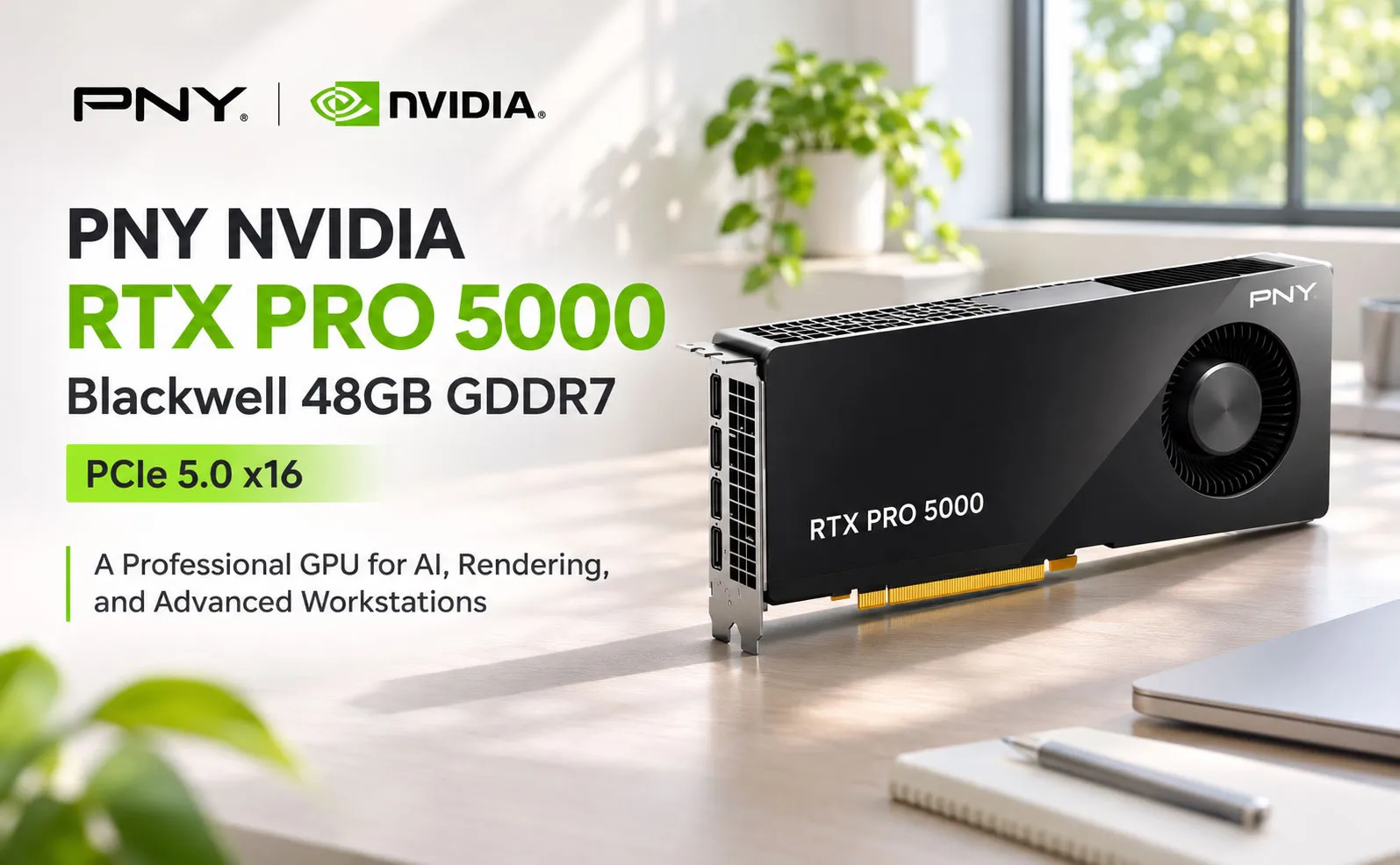
PNY NVIDIA RTX PRO 5000 Blackwell 48GB GDDR7 PCIe 5.0 x16: A Professional GPU for AI, Rendering, and Advanced Workstations
The PNY NVIDIA RTX PRO 5000 Blackwell 48GB GDDR7 PCIe 5.0 x16 is a professional graphics card designed for demanding workstation environments, artificial intelligence development, deep learning, 3D rendering, engineering simulation, and advanced content creation.
Built on NVIDIA’s Blackwell architecture, the RTX PRO 5000 combines 14,080 CUDA cores, 440 fifth-generation Tensor Cores, and 110 fourth-generation RT Cores. With 48GB of GDDR7 memory featuring Error-Correcting Code (ECC), it provides the memory capacity and computational capabilities required for complex professional workloads.
Unlike mainstream gaming GPUs, the RTX PRO 5000 is designed to support professional applications where memory capacity, computational acceleration, graphics reliability, and workstation integration are essential.
This article explores the technical specifications, AI capabilities, memory architecture, professional applications, system requirements, and key considerations when choosing the PNY NVIDIA RTX PRO 5000 Blackwell 48GB.
1. NVIDIA Blackwell Architecture: The Foundation of RTX PRO 5000
The NVIDIA Blackwell architecture introduces a new generation of GPU technology designed to accelerate artificial intelligence, neural graphics, ray tracing, and professional computing workloads.
The RTX PRO 5000 Blackwell benefits from several architectural improvements, including fifth-generation Tensor Cores, fourth-generation RT Cores, and advanced CUDA processing capabilities.
These technologies enable the GPU to handle multiple types of professional workloads, from AI inference and neural network processing to complex visualization and real-time rendering.
For professionals working with AI applications, Blackwell architecture provides an accelerated computing platform that supports modern AI software frameworks and NVIDIA’s CUDA ecosystem.
2. PNY RTX PRO 5000 48GB GDDR7: Memory Capacity and Bandwidth
One of the most important features of the PNY RTX PRO 5000 is its 48GB GDDR7 graphics memory with ECC support.
Memory capacity plays a critical role in professional GPU workloads, particularly when working with large datasets, complex 3D scenes, neural networks, and large language models.
The card features a 384-bit memory interface and delivers up to 1,344 GB/s of memory bandwidth.
Why Does 48GB GPU Memory Matter for AI?
AI workloads often require substantial GPU memory to store model weights, intermediate activations, input data, and attention-related computations.
A GPU with 48GB of VRAM provides more flexibility when running local AI models compared with graphics cards equipped with smaller memory capacities.
The RTX PRO 5000 can be used for:
- Local Large Language Model (LLM) inference.
- Generative AI development.
- Deep learning experimentation.
- Computer vision applications.
- Neural network inference.
- AI-assisted image and video processing.
However, the ability to run a specific AI model depends on its parameter count, numerical precision, quantization method, context length, and runtime memory requirements.
What Is ECC Memory in the RTX PRO 5000?
ECC stands for Error-Correcting Code. It is a memory technology designed to detect and correct certain types of memory errors.
For professional environments involving scientific computing, engineering applications, and long-running computational workloads, ECC memory can improve data integrity and system reliability.
3. NVIDIA RTX PRO 5000 for AI and Large Language Models (LLMs)
The PNY NVIDIA RTX PRO 5000 Blackwell 48GB is particularly relevant to organizations and developers building local AI infrastructure.
Its combination of 48GB GPU memory, CUDA processing, and fifth-generation Tensor Cores makes it suitable for various AI development and inference workloads.
Running Local LLMs on RTX PRO 5000 48GB
Local LLM deployment allows organizations to run supported language models on their own hardware rather than relying entirely on cloud-based AI services.
With 48GB of GPU memory, the RTX PRO 5000 can accommodate several quantized language models, depending on model size and inference configuration.
Potential applications include:
- Private AI assistants.
- Enterprise knowledge management systems.
- Document analysis and summarization.
- Internal AI chatbots.
- Retrieval-Augmented Generation (RAG) systems.
- AI-powered development tools.
For example, developers can use software frameworks such as Ollama, vLLM, and compatible inference engines to experiment with local language model deployment.
The actual performance and compatibility depend on the software version, CUDA support, model architecture, and available memory.
Is RTX PRO 5000 Suitable for AI Model Training?
Yes. The GPU can accelerate deep learning training and inference through CUDA and Tensor Core technologies.
It can support experimentation, fine-tuning, and training workflows involving models that fit within its available memory and computational resources.
However, training very large foundation models from scratch generally requires multiple GPUs or larger-scale computing infrastructure.
For many professional users, the RTX PRO 5000 is better positioned as a powerful workstation GPU for AI development, inference, experimentation, and selected training workloads.
4. RTX PRO 5000 for 3D Rendering and Professional Visualization
Artificial intelligence is not the only application of the RTX PRO 5000.
The GPU is also designed for professional graphics workloads, including 3D modeling, architectural visualization, animation, and engineering applications.
Its 110 fourth-generation RT Cores accelerate ray-tracing operations, enabling more efficient rendering of realistic lighting, reflections, and shadows in supported applications.
Professional applications can benefit from its GPU architecture and graphics memory when working with:
- Complex 3D models.
- Large architectural scenes.
- High-resolution textures.
- Real-time visualization.
- Product design and prototyping.
- Animation and visual effects.
- Engineering visualization.
The 48GB memory capacity is particularly useful for projects involving large assets and complex scenes that require substantial graphics memory.
5. Advanced Ray Tracing and Fourth-Generation RT Cores
Ray tracing is a rendering technique that simulates the behavior of light to produce realistic visual results.
The NVIDIA RTX PRO 5000 incorporates 110 fourth-generation RT Cores designed to accelerate ray-tracing calculations.
These specialized processing units can improve supported rendering workflows by accelerating:
- Realistic lighting calculations.
- Reflections and refractions.
- Shadow generation.
- Global illumination.
- Complex visual effects.
For professionals using GPU-accelerated rendering software, RT Cores can help improve workflow efficiency and reduce rendering time, depending on the application and scene complexity.
6. Fifth-Generation Tensor Cores for AI Acceleration
Tensor Cores are specialized GPU processing units designed to accelerate matrix operations commonly used in artificial intelligence and deep learning.
The RTX PRO 5000 features 440 fifth-generation Tensor Cores.
These cores accelerate supported AI computations, including neural network inference, matrix multiplication, and AI-enhanced graphics operations.
They are particularly important for modern AI workloads that rely on lower-precision numerical formats and optimized neural network execution.
Combined with NVIDIA’s software ecosystem, Tensor Cores make the RTX PRO 5000 a suitable platform for professional AI development and deployment.
7. NVIDIA RTX PRO 5000 PCIe 5.0 x16 Interface
The RTX PRO 5000 uses a PCI Express 5.0 x16 system interface.
PCIe 5.0 provides high-bandwidth communication between the GPU and the host workstation, supporting demanding professional applications and data-intensive workflows.
For organizations building AI workstations, PCIe compatibility is an important consideration when selecting motherboards, processors, and system configurations.
Although the GPU supports PCIe 5.0 x16, compatibility with other PCIe generations depends on the host platform.
8. Multi-Instance GPU (MIG) Support in RTX PRO 5000
The RTX PRO 5000 supports NVIDIA Multi-Instance GPU (MIG) technology.
MIG allows supported GPU resources to be partitioned into separate GPU instances, enabling multiple workloads to operate with dedicated GPU resources.
According to the PNY product specifications, the RTX PRO 5000 supports the following MIG configurations:
- One GPU instance with 48GB of memory.
- Up to two GPU instances with 24GB of memory each.
This capability can be useful for organizations running multiple independent AI inference workloads or separate computing environments.
MIG configuration and availability depend on supported software, drivers, and the GPU deployment environment.
9. RTX PRO 5000 for Video Editing and Content Creation
The RTX PRO 5000 also supports professional video production and media processing workflows.
Its hardware video engines include:
- Two ninth-generation NVENC engines.
- Two sixth-generation NVDEC engines.
These dedicated engines accelerate supported video encoding and decoding operations.
They can be useful for professional workflows involving:
- Video editing.
- High-resolution media processing.
- Live streaming.
- Video encoding and transcoding.
- Content production.
- Media pipeline acceleration.
The GPU also includes four DisplayPort 2.1b connectors, supporting advanced multi-display workstation configurations.
10. PNY NVIDIA RTX PRO 5000 Blackwell Technical Specifications
The following table summarizes the main technical specifications of the PNY NVIDIA RTX PRO 5000 Blackwell 48GB.
| Specification | Details |
|---|---|
| GPU Model | NVIDIA RTX PRO 5000 Blackwell |
| Manufacturer | PNY |
| GPU Architecture | NVIDIA Blackwell |
| CUDA Cores | 14,080 |
| Tensor Cores | 440, 5th Generation |
| RT Cores | 110, 4th Generation |
| GPU Memory | 48GB GDDR7 with ECC |
| Memory Interface | 384-bit |
| Memory Bandwidth | 1,344 GB/s |
| System Interface | PCI Express 5.0 x16 |
| Display Connectors | 4x DisplayPort 2.1b |
| Video Encoding | 2x 9th Generation NVENC |
| Video Decoding | 2x 6th Generation NVDEC |
| MIG Support | Up to 2x 24GB or 1x 48GB |
| Total Board Power | 300W |
| Power Connector | 1x PCIe CEM5 16-pin |
| Thermal Solution | Active Cooling |
| Form Factor | Full Height, Dual Slot |
| Dimensions | 4.4″ H x 10.5″ L |
11. System Requirements for Installing RTX PRO 5000
Before purchasing the PNY RTX PRO 5000, it is important to verify that the workstation can accommodate the GPU.
The following components should be considered:
Motherboard and PCIe Slot
A compatible PCIe expansion slot is required. PCIe 5.0 x16 is the preferred interface for the card.
Power Supply
The GPU has a total board power of 300W and requires a PCIe CEM5 16-pin power connector. The complete system power requirements should be evaluated before selecting a power supply.
Physical Space
The card uses a full-height, dual-slot design. The workstation chassis must provide sufficient installation clearance.
Cooling and Airflow
An active cooling solution is integrated into the card. However, adequate airflow inside the workstation remains important for stable operation under sustained workloads.
Software Compatibility
Users should verify compatibility with NVIDIA drivers, CUDA, operating systems, and the specific professional applications they intend to use.
12. RTX PRO 5000 Blackwell vs RTX PRO 6000 Blackwell
Professionals considering an NVIDIA Blackwell workstation GPU may also evaluate the RTX PRO 6000 series.
Both products are designed for professional graphics and AI workloads, but they target different performance and memory requirements.
The RTX PRO 5000 Blackwell provides 48GB of GDDR7 memory, while the RTX PRO 6000 Blackwell Workstation Edition offers up to 96GB of GDDR7 memory.
This difference can be important for users working with larger AI models, complex 3D scenes, and memory-intensive applications.
The RTX PRO 5000 is a compelling option for professional workstations that require substantial GPU memory and advanced AI acceleration without necessarily needing the larger memory capacity of the RTX PRO 6000.
The appropriate choice depends on workload size, software requirements, performance expectations, and overall system budget.
13. Who Should Buy the PNY NVIDIA RTX PRO 5000 48GB?
The PNY RTX PRO 5000 Blackwell is designed for professionals and organizations that require advanced GPU acceleration in workstation environments.
It is particularly relevant to:
AI Developers and Machine Learning Engineers
For local LLM inference, deep learning experimentation, and AI application development.
Research Institutions and Universities
For GPU-accelerated scientific computing, neural network research, and data-intensive experiments.
Architects and 3D Designers
For professional rendering, visualization, and complex modeling workflows.
Video Production Studios
For accelerated media processing, editing, and content creation.
Enterprise IT Teams
For developing workstation-based AI infrastructure and professional computing environments.
14. Where to Buy PNY NVIDIA RTX PRO 5000 Blackwell 48GB?
Selecting the right professional GPU requires more than comparing memory capacity and processing cores. Compatibility, workload requirements, system configuration, and supply conditions should also be evaluated.
SADID Gostaran provides access to professional AI hardware and advanced computing solutions for businesses, developers, research institutions, and enterprise customers.
If you are looking for the PNY NVIDIA RTX PRO 5000 Blackwell 48GB GDDR7 PCIe 5.0 x16, you can explore product availability and request purchasing information through SADID Gostaran.
Visit the product page:
PNY NVIDIA RTX PRO 5000 Blackwell 48GB – SADID Gostaran
You can also explore the complete range of AI GPUs and professional graphics cards and other AI computing equipment.
For enterprise procurement, project-based requirements, and official quotations, contact the SADID Gostaran team.
Frequently Asked Questions About PNY NVIDIA RTX PRO 5000 Blackwell 48GB
Is the NVIDIA RTX PRO 5000 Blackwell good for AI?
Yes. The RTX PRO 5000 combines 48GB of GDDR7 ECC memory, 440 fifth-generation Tensor Cores, and NVIDIA Blackwell architecture, making it suitable for AI development, inference, and selected deep learning workloads.
Can RTX PRO 5000 run local LLMs?
Yes. Its 48GB of GPU memory allows compatible quantized large language models to run locally, depending on model size, context length, quantization, and runtime requirements.
How much VRAM does the PNY RTX PRO 5000 have?
The PNY NVIDIA RTX PRO 5000 Blackwell includes 48GB of GDDR7 graphics memory with ECC support.
Does RTX PRO 5000 support PCIe 5.0?
Yes. It features a PCI Express 5.0 x16 system interface.
What is the power consumption of RTX PRO 5000?
The total board power is rated at 300W. The card uses a PCIe CEM5 16-pin power connector.
Is RTX PRO 5000 suitable for 3D rendering?
Yes. Its CUDA cores, fourth-generation RT Cores, and 48GB graphics memory support demanding professional rendering, visualization, and 3D design workflows.
What is the difference between RTX PRO 5000 and RTX PRO 6000?
The RTX PRO 5000 Blackwell features 48GB of GDDR7 memory, while the RTX PRO 6000 Blackwell Workstation Edition offers up to 96GB. The RTX PRO 6000 is intended for workloads that require greater memory capacity and higher overall processing resources.
Official References and Technical Resources
- PNY Technologies. NVIDIA RTX PRO 5000 Blackwell GPU – Official Product Page
- PNY Technologies. NVIDIA RTX PRO 5000 Blackwell – Official Technical Datasheet
- NVIDIA. RTX PRO 5000 Blackwell – Professional GPU Information
- PNY Technologies. NVIDIA RTX PRO Blackwell Architecture – Product Comparison
Article Summary: The PNY NVIDIA RTX PRO 5000 Blackwell 48GB is a professional workstation GPU combining NVIDIA Blackwell architecture, high-capacity GDDR7 ECC memory, advanced Tensor Cores, and PCIe 5.0 connectivity. It is designed for demanding AI, rendering, engineering, and professional computing workflows.