NVIDIA DGX Spark 200Gb QSFP56 DAC Cable Commercial Guide
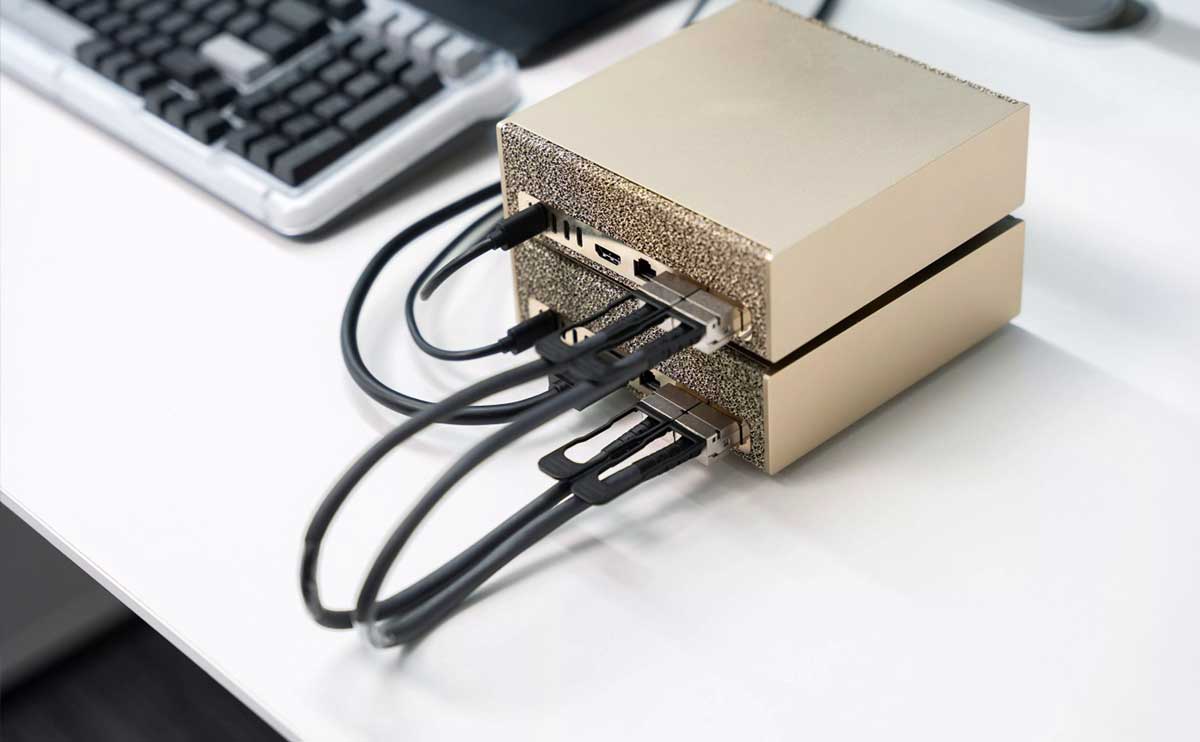
NVIDIA DGX Spark High-Speed 200Gb QSFP56 DAC Cable: Optimizing Enterprise AI Cluster Interconnectivity
As enterprises scale their artificial intelligence workloads, build distributed deep learning clusters, and deploy multi-node supercomputing environments, physical networking infrastructure becomes the primary bottleneck determining overall compute efficiency. While powerful processing nodes like the NVIDIA DGX Spark deliver unprecedented local tensor performance, transferring multi-terabyte training datasets between compute nodes, storage area networks (SANs), and high-speed switches requires specialized interconnects. The NVIDIA DGX Spark High-Speed 200Gb QSFP56 Direct Attach Copper (DAC) Cable provides the ultra-low latency and high-throughput physical connectivity required to keep high-density AI nodes fully saturated.
Distributed internationally by SADID FZE—operating out of Dubai’s world-renowned Jebel Ali Free Zone (JAFZA), UAE—this enterprise interconnect solution guarantees maximum signal integrity, zero cable latency delay, and operational energy efficiency. This guide details the engineering specifications, networking topologies, commercial benefits, and procurement strategies for deploying 200Gb QSFP56 DAC cables within high-performance IT environments.
1. Technical Architecture and Hardware Specifications
Direct Attach Copper (DAC) technology utilizes twinaxial copper cables integrated directly into high-density transceiver shells. Designed explicitly for short-reach, high-bandwidth interconnectivity within data center server racks, the NVIDIA 200Gb QSFP56 DAC cable bypasses the optical conversion overhead found in traditional fiber optic transceivers, delivering instantaneous data transfer.
Key Hardware Specifications:
- Data Transfer Rate: 200 Gigabits per second (Gbps) continuous bidirectional throughput utilizing 4-channel 50G PAM4 modulation.
- Form Factor: Industry-standard QSFP56 (Quad Small Form-factor Pluggable 56) connectors with integrated latching mechanisms.
- Cable Construction: High-grade shielded twinaxial copper wiring with low insertion loss and high EMI (Electro-Magnetic Interference) immunity.
- Power Consumption: Passive electrical design requiring 0 Watts of power consumption, significantly reducing overall rack thermal output.
- Protocol Compliance: Fully compliant with IEEE 802.3cd 200GBASE-CR4, SFF-8665, and InfiniBand HDR interconnect specifications.
By implementing passive 200Gb QSFP56 DAC cables between DGX Spark nodes and enterprise switches, network architects achieve sub-microsecond latency propagation. This zero-latency data pipeline prevents high-value Tensor Cores from stalling while waiting for data packet arrival during large-scale model synchronization.
2. Enterprise Network Topologies and Use Cases
High-speed physical cabling is vital in mission-critical environments where data drops or latency spikes directly impact commercial outputs.
A. Interconnecting Multi-Node NVIDIA DGX Spark Clusters
When chaining multiple NVIDIA DGX Spark AI supercomputers into a unified compute fabric, inter-node communication bandwidth dictates scaling efficiency. Utilizing 200Gb QSFP56 DAC cables ensures seamless gradient exchanges during distributed Large Language Model (LLM) training and multi-GPU parallelism.
B. Direct-Attach Storage (DAS) and NVMe-over-Fabrics (NVMe-oF)
Enterprise AI training pipelines require instantaneous access to vast training data repositories. Connecting storage arrays to compute nodes via 200Gb DAC links allows NVMe drives to operate at maximum PCI-Express speeds across the network, eliminating local I/O bottlenecks.
C. High-Frequency Algorithmic Trading Infrastructure
In financial technology and quantitative trading networks, every microsecond of physical network delay translates to financial loss. Passive copper DAC cables provide the absolute lowest physical layer latency possible, making them mandatory for high-frequency trading server racks.
D. Edge Data Centers and Private AI Infrastructure
For research labs, smart healthcare centers, and industrial automation hubs building localized data centers, short-reach intra-rack cabling demands high durability. The rugged construction of QSFP56 DAC cables prevents connection degradation caused by server vibration or thermal cycling.
3. Commercial Advantages and Financial Return on Investment (ROI)
Selecting the correct networking infrastructure through SADID FZE directly impacts both initial capital expenditure (CapEx) and long-term operational costs (OpEx).
1. Significant Capital Cost Reduction vs. Active Optical Cables
Active Optical Cables (AOC) and optical transceivers require expensive laser diodes and optical-to-electrical conversion chips within each connector. Passive 200Gb QSFP56 DAC cables cost significantly less per link while offering superior physical durability for intra-rack runs under 3 meters.
2. Zero Power Consumption & Reduced Cooling Overhead
Optical transceivers generate noticeable heat and consume several watts per port across high-density switches. Passive copper DAC cables consume zero electrical power and produce zero heat. Multiplied across hundreds of switch ports in an enterprise data center, this yields substantial annual electricity and HVAC cooling savings.
3. High Operational Reliability and Plug-and-Play Simplicity
With no active optical components to degrade or fail over time, passive DAC cables exhibit near-zero failure rates. Enterprise IT teams benefit from instant plug-and-play compatibility, minimizing network maintenance downtime and emergency replacement costs.
4. Physical Interconnect Comparison Matrix
The matrix below highlights why 200Gb QSFP56 DAC cables are the preferred choice for short-reach AI server connections:
| Feature / Parameter | Standard 10G/40G Copper | 200G Active Optical Cable (AOC) | NVIDIA 200Gb QSFP56 DAC Cable |
|---|---|---|---|
| Maximum Throughput | 10 Gbps – 40 Gbps | 200 Gbps | 200 Gbps (PAM4 High-Speed) |
| Physical Latency | Medium | Low (Adds E/O Conversion Delay) | Ultra-Low (Sub-microsecond Direct Transmission) |
| Power Consumption | Low | 1.5W – 3.5W per connector end | 0 Watts (Passive Electrical Design) |
| Optimal Reach | Up to 10 Meters | Up to 100+ Meters | Up to 3 Meters (Intra-Rack Server Interconnect) |
| Procurement Cost Efficiency | Legacy / Low Cost | High CapEx | Maximum Commercial ROI for Short Runs |
5. Strategic B2B Supply and Procurement with SADID FZE
Ensuring absolute hardware compatibility is critical when deploying high-density 200Gb network fabrics. SADID FZE provides comprehensive B2B technology distribution services out of Dubai, UAE, supplying verified networking components, enterprise servers, and AI compute acceleration hardware to global client networks.
Partnering with SADID FZE gives enterprise procurement managers access to guaranteed original NVIDIA interconnect products, international shipping compliance, competitive B2B pricing, and long-term commercial trade support.
6. Technical References and Industry Standards
- NVIDIA Networking & High-Speed Interconnect Solutions: https://www.nvidia.com/en-us/networking/
- Ethernet Technology Consortium 200G Specifications: https://ethernettechnologyconsortium.org/
- SNIA Optical and Copper Infrastructure Guidelines: https://www.snia.org/